Apple Mail Privacy Protection & Dynamic Email Images: What Still Works
What Apple Mail Privacy Protection Does
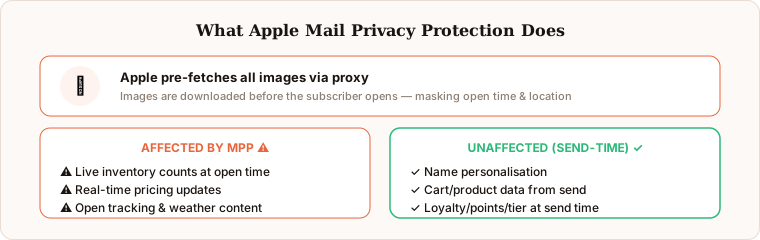
Apple Mail Privacy Protection (MPP) was introduced with iOS 15 in September 2021 and fundamentally changed how dynamic email content works for a large portion of email subscribers. MPP pre-fetches all email content, including images, through Apple proxy servers at the time of email delivery rather than when the subscriber actually opens the email.
This means that for Apple Mail users, the "moment of open" that open-time content tools rely on is actually the moment of delivery. Any image designed to show fresh data when the subscriber opens the email is instead rendered with data from the delivery moment.
For the broader context on email image personalisation and how it relates to caching challenges, see our complete guide. For Gmail-specific caching, see our Gmail caching guide.
How Large Is the MPP Impact?
Apple Mail consistently accounts for roughly 50-60% of all email opens, depending on your audience. For consumer e-commerce brands with a mobile-heavy subscriber base, the percentage can be even higher.
This means that more than half of your subscribers may be affected by MPP pre-fetching behaviour. Any email strategy that depends on true open-time rendering needs to account for this reality.
What MPP Breaks
The primary casualty is content that needs to be fresh at the actual moment of opening:
Live inventory counts: If your email image shows "Only 3 left in stock" but the subscriber opens the email hours after delivery, the number may have changed. MPP locks the number at delivery time.
Real-time pricing: Dynamic pricing that updates based on current offers will be frozen at the delivery-time price for Apple Mail users.
Weather-based content: Images that show local weather at the time of open will instead show the weather at time of delivery, which could be hours or days earlier.
Open-tracking reliability: MPP triggers tracking pixels at delivery, not open, which inflates open rates and makes them unreliable as a metric for Apple Mail subscribers.
What MPP Does Not Break
This is the good news. The most common and effective forms of email image personalisation work perfectly despite MPP:
Name personalisation: When the subscriber name is embedded in the image URL at send time (which is how Driphue works), MPP has zero impact. The pre-fetched image already contains the correct name because it was resolved at delivery time, which is also send time.
Welcome email images: A personalised welcome banner with the subscriber name works flawlessly. The name is in the URL, the image renders correctly at pre-fetch time, and the subscriber sees their name when they actually open.
Cart abandonment images: Product name, subscriber name, and price data that is set at send time works perfectly. The image URL already contains all the personalisation data.
Loyalty and points displays: Points balance and tier status set at send time render correctly. The data does not need to change between send and open.
Location personalisation: City or region data pulled from subscriber profiles works because it is embedded in the URL at send time.
Segment-based imagery: Different images for different customer segments work because each segment gets a unique URL.
The Practical Strategy: Send-Time Personalisation
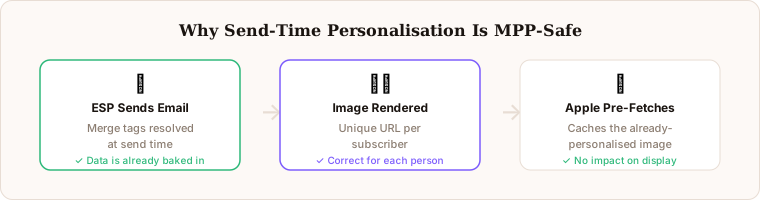
The most reliable approach to email image personalisation in a post-MPP world is to design around send-time data. This means using subscriber data that is known and stable at the moment the email is sent: names, locations, purchase history, loyalty data, and segment membership.
This is exactly how Driphue operates. Your personalised image URL contains merge tags that your ESP replaces with subscriber data at send time. The image server renders the personalised image when the URL is first requested, whether that request comes from MPP pre-fetching or the subscriber actually opening the email. The result is identical either way.
How Driphue Handles MPP
Driphue is designed around send-time personalisation, which makes it inherently MPP-compatible. Here is why:
Unique URLs per subscriber: Each subscriber gets a distinct image URL containing their specific data. Whether MPP pre-fetches it or the subscriber opens it directly, the same personalised image is rendered.
No dependency on open-time freshness: Driphue does not rely on fetching live data at the moment of open. All personalisation data is encoded in the URL by your ESP before delivery.
Works with any ESP: Whether you use Klaviyo, Mailchimp, HubSpot, or any other ESP, the MPP-safe workflow is the same.
Questions to Ask Your Current Tool
If you are using another email image personalisation tool, ask them directly: how does your product handle Apple Mail Privacy Protection? If the answer is vague, that is a red flag. If they claim MPP does not affect their product at all, that is not accurate — MPP affects all email image tools. The honest answer is that send-time personalisation works and open-time-dependent features are limited for Apple Mail users.
For a transparent comparison of how different tools handle these challenges, see our email personalisation tools comparison or our specific comparison of Driphue vs NiftyImages.
Keep reading
More from the blog
 Email Personalization
The E-commerce Guide to Email Image Personalisation: From First Image to Full Automation
11 min read Email Personalization
Email Image Personalisation Tools Compared: Driphue vs NiftyImages vs Hyperise vs OKZest
10 min read Email Personalization
Email Image Personalization: The Complete Guide for E-Commerce Brands in 2026
8 min read
Personalise every image in your emails
Turn your Klaviyo, Brevo or any-ESP campaigns into dynamic, per-subscriber images and countdown timers — no code required.