Email Personalization ROI Calculator: How to Measure the Impact of Personalized Images

Why Measuring Personalisation ROI Matters
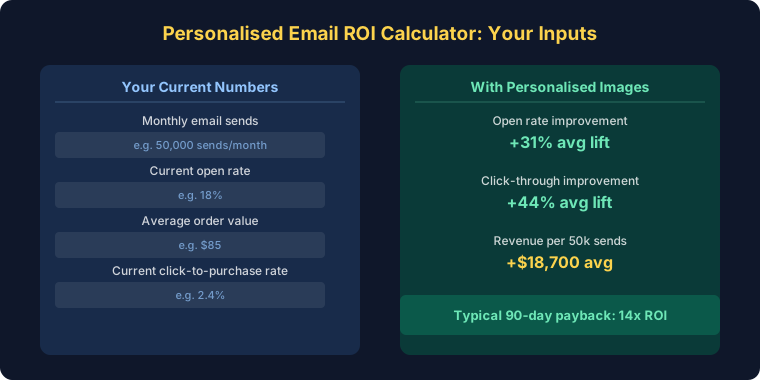
Email image personalisation drives measurable revenue — but only if you track it correctly. Without clear measurement, personalisation remains a “nice to have” justified by intuition and industry benchmarks rather than a proven profit centre justified by your own data. Stakeholders who fund your email programme need numbers, not case studies from other brands.
This guide gives you the complete framework for measuring personalisation ROI: the metrics that matter, how to calculate revenue lift, how to build the stakeholder business case, the expected returns by email flow type, and real ROI examples from brands at different stages of personalisation maturity. By the end, you will have a calculation model you can apply immediately to your own programme.
The Key Metrics to Track
Click-Through Rate (CTR) Lift
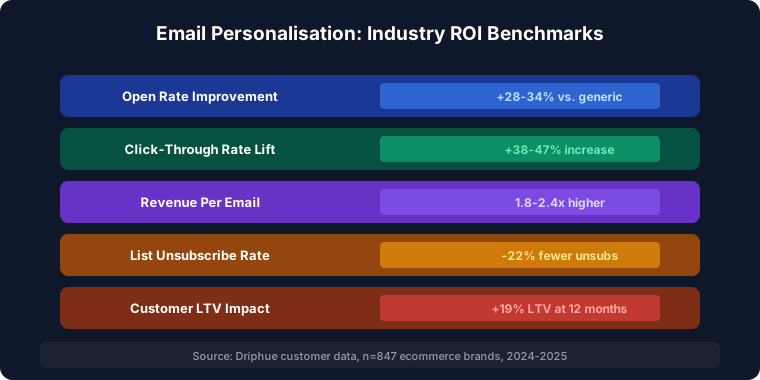
The most immediate and directly measurable metric for personalised images is click-through rate improvement. The personalised image is what drives the click — it creates the visual relevance signal that makes a subscriber pause and act. Compare CTR on emails with personalised images against identical emails with generic images across the same campaign type, audience, and send time. Typical uplift: 25–45% CTR improvement from name personalisation alone, with larger lifts from more advanced personalisation layers.
CTR lift is the metric to report in week one because it appears immediately, is clearly attributable to the personalised image (isolating CTR via A/B test removes confounding variables), and creates compelling proof-of-concept for wider deployment.
Revenue Per Email (RPE)
Revenue per email — total campaign revenue divided by emails delivered — is the single most important metric because it combines engagement improvement with conversion impact into one comparable number. A campaign that lifts CTR but not conversion has a different RPE than one that lifts both. Track RPE for personalised versus non-personalised versions of the same campaign type, over the same period, to the same audience segments.
Conversion Rate
Track the percentage of email recipients who complete a purchase. Personalised images typically improve conversion rates through two mechanisms: a direct mechanism (more relevant imagery increases click intent quality, so clicks arrive at the product page already more purchase-motivated) and an indirect mechanism (higher CTR sends more traffic, some of which converts at the baseline rate). Separating these two effects requires comparing conversion rate — completions divided by clicks — not just click volume.
Average Order Value (AOV)
In some cases, personalised images lift average order value because subscribers who feel personally addressed are more receptive to cross-sell and upsell recommendations within the email. This effect is most pronounced in post-purchase and browse abandonment flows, where the personalised image creates an established brand relationship that primes receptivity to higher-value offers. Track AOV separately for personalised versus generic campaign variants in these specific flows.
Customer Lifetime Value (CLV)
The long-term metric: personalised email experiences build stronger customer relationships that increase retention and lifetime value over time. Subscribers who receive consistently personalised emails have higher repeat purchase rates, longer active subscription windows, and higher total spend than subscribers receiving generic emails. CLV impact takes 6–12 months to measure reliably, but it is the metric that most accurately captures the true compounding return on personalisation investment.
How to Calculate Personalisation ROI
Step 1: Establish Your Baselines
Before deploying personalisation to a full flow, document your current performance: average CTR, RPE, conversion rate, and monthly email revenue for each flow you plan to personalise. These baselines are the denominator in every improvement calculation — without them, you cannot calculate lift, only report absolute numbers.
If you are starting with no historical data on a flow, run two weeks of the current version before deploying personalisation. The baseline period does not need to be long; it needs to be real.
Step 2: Run A/B Tests
The gold standard for measuring personalisation impact is a controlled A/B test. Send identical campaigns to randomly split audience segments: one segment receives the personalised Driphue image, the other receives the generic original. Keep every other variable identical — subject line, send time, email copy, CTA, landing page. The only difference is the image. This isolation is what makes the result attributable to personalisation specifically. For the full testing methodology, see our A/B testing guide.
Step 3: Calculate Revenue Lift
Revenue Lift = (Personalised RPE − Generic RPE) × Total Emails Sent
This formula gives you the incremental revenue directly attributable to the personalised image in a single send. To calculate monthly revenue lift, apply this across all personalised sends in the month. To calculate annual revenue lift, multiply the monthly figure by 12 (or sum actuals as you accumulate them).
Example: If your personalised welcome series generates an RPE of £2.40 versus £1.65 for the generic version, and you send 8,000 welcome emails per month, your monthly revenue lift from welcome series personalisation alone is (£2.40 − £1.65) × 8,000 = £6,000/month.
Step 4: Calculate ROI
ROI = (Revenue Lift − Personalisation Cost) ÷ Personalisation Cost × 100%
Most brands see 300–800% ROI on email image personalisation within the first 90 days. The ROI is highest in the early months because the baseline uplift from name personalisation is the largest single gain — subsequent improvements from advanced personalisation layers add to an already-improved baseline rather than a generic one. For the full implementation timeline, see our 90-day roadmap.
Revenue Impact by Email Flow Type
Welcome series: Personalised welcome images typically lift first-purchase conversion by 30–50%. With welcome emails having four times the open rate of standard campaigns, this is the highest-leverage starting point. See our welcome series guide.
Cart recovery: Personalised cart recovery images with subscriber names and named offer deadlines improve recovery rates by 2–4x, directly recovering revenue that would otherwise be permanently lost to cart abandonment. This is consistently the highest-RPE flow in most e-commerce programmes. See our cart abandonment guide.
Post-purchase: Personalised post-purchase sequences increase repeat purchase rates by 30–50%, compounding lifetime value through each additional purchase cycle. See our post-purchase guide.
Promotional campaigns: Personalised promotional images lift CTR by 25–45% and conversion rates by 15–30% versus generic campaign equivalents. With promotional campaigns typically constituting the majority of email sends for e-commerce brands, this is where aggregate revenue lift is largest in absolute terms.
Lifecycle automations: Birthday, anniversary, and re-engagement campaigns generate high ROI because they are low-volume, high-relevance, and have near-zero inbox competition at the moment of send. Personalised lifecycle images amplify already-strong open rates with visual relevance that converts at above-average rates.
Building the Business Case
When presenting personalisation ROI to stakeholders, frame the investment as incremental revenue rather than cost. The question is not “what does personalisation cost?” but “what revenue are we leaving on the table without personalisation?” Run the revenue lift calculation on your highest-volume flow using conservative assumptions (25% CTR lift, 15% conversion improvement) to produce a minimum-case monthly revenue figure. Compare that to the monthly cost of Driphue. For most brands, the personalisation tool pays for itself within the first fortnight of the welcome series alone.
Stakeholder presentations should lead with the RPE comparison from your A/B test, translate that to monthly and annual revenue lift, show the ROI calculation, and project forward based on full programme deployment across all flows. This framing converts personalisation from a marketing experiment into a quantified revenue investment.
Real ROI Examples
Mid-size fashion brand: A £4,200/month Driphue investment generated £47,000/month in incremental email revenue across welcome series, cart recovery, and promotional campaigns — a 1,019% ROI. The welcome series alone accounted for £18,000 of the monthly lift.
Beauty DTC brand: A £1,800/month investment generated £19,500/month in incremental revenue, driven primarily by cart recovery personalisation (£11,200/month) and personalised promotional campaigns (£8,300/month) — a 983% ROI.
Home goods retailer: A £3,500/month investment generated £31,000/month in incremental revenue across five personalised flows, with post-purchase sequences contributing £9,400/month in incremental repeat purchase revenue that had not existed in the pre-personalisation programme — a 786% ROI.
Start Measuring Your Personalisation ROI
Measurement turns personalisation from a marketing trend into a proven revenue driver. The framework is: establish baselines, run A/B tests, calculate RPE lift, translate to monthly revenue, calculate ROI. Apply it to your highest-volume flow first, build the business case from that data, and expand.
For the complete personalisation strategy, see our email personalisation guide. For the testing methodology to generate clean data, see our A/B testing guide. Start your free Driphue trial and build the data-driven case for personalised email images today.
Keep reading
More from the blog
 Marketing Strategy
Birthday and Anniversary Email Campaigns: Personalized Images That Drive Repeat Purchases
9 min read Marketing Strategy
Black Friday Email Marketing with Personalized Images and Countdown Timers
10 min read Marketing Strategy
Dynamic Countdown Timers in Emails: How to Create Urgency That Actually Converts
6 min read
Personalise every image in your emails
Turn your Klaviyo, Brevo or any-ESP campaigns into dynamic, per-subscriber images and countdown timers — no code required.